
Your Mutual Fund Portfolio May Be More Aggressive Than You Think
You may own 5–6 mutual funds. But do you really know how much risk you're taking?
“I have six mutual funds, so my portfolio is well diversified.”
We hear this quite often.
And at first glance, it sounds right.
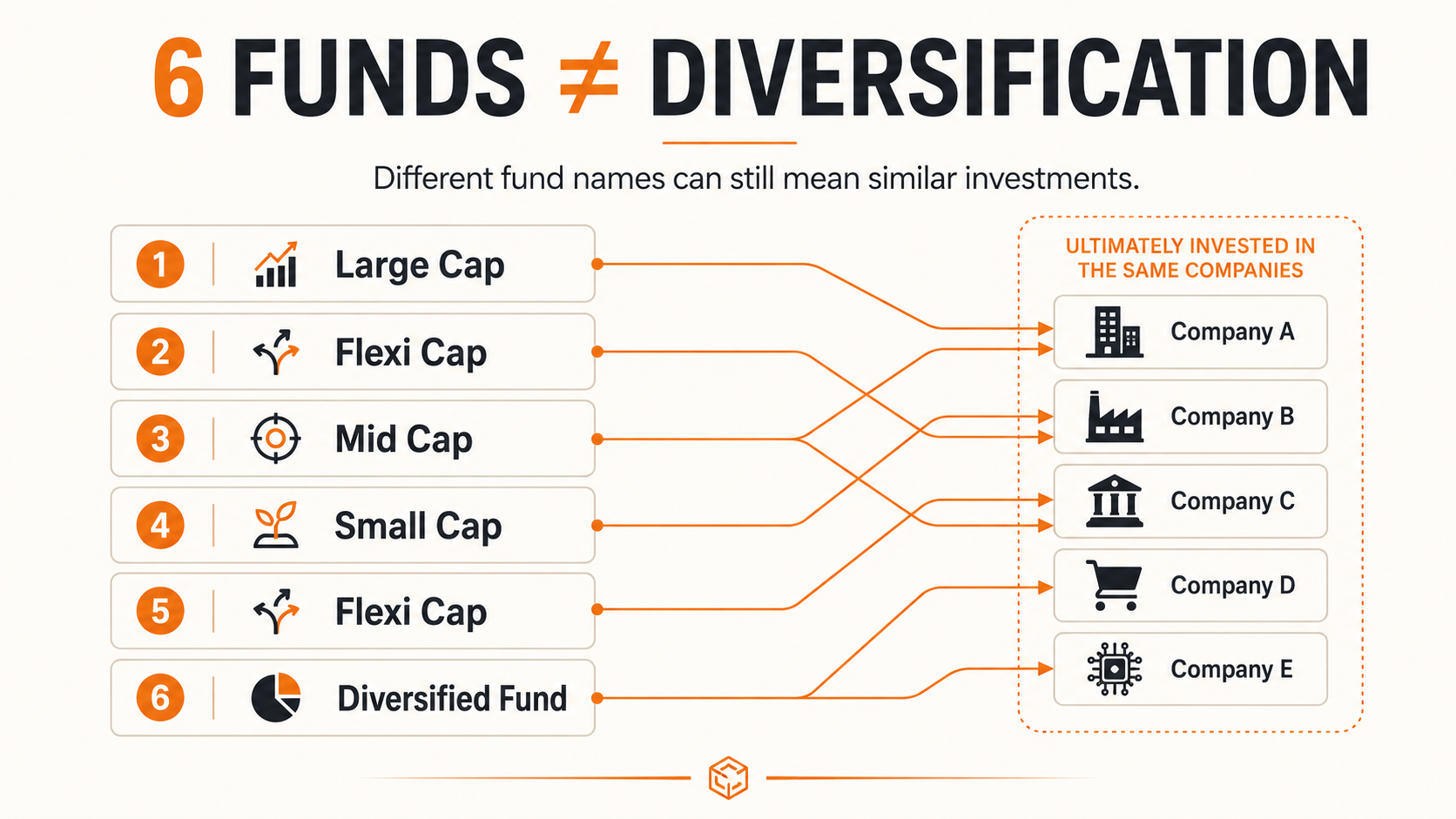
You may have a Large Cap Fund, a Flexi Cap Fund, a Mid Cap Fund, a Small Cap Fund and perhaps another diversified equity fund.
Five or six different names. Five or six different fund managers.
It certainly looks diversified.
But there is one question many investors don't ask:
How different are these funds actually?
Because owning more mutual funds does not automatically mean taking less risk.
Sometimes, you may simply be buying different funds that invest in many of the same companies—or adding more and more exposure to mid- and small-sized companies without realizing it.
And when markets fall, that difference can suddenly become very important.
Let's look at a simple example
Imagine an investor has ₹20 lakh invested across five mutual funds:
|
Fund |
Investment |
|
Flexi Cap Fund |
₹5 lakh |
|
Large & Mid Cap Fund |
₹4 lakh |
|
Mid Cap Fund |
₹4 lakh |
|
Small Cap Fund |
₹4 lakh |
|
Another Flexi Cap Fund |
₹3 lakh |
|
Total |
₹20 lakh |
The investor may feel comfortable because the money is spread across five funds.
But this is only the first layer.
The next question is:
How much of that ₹20 lakh is actually invested in large companies, mid-sized companies and small companies?
A Flexi Cap Fund, for example, is not necessarily a pure large-company investment.
Data through March 2026 shows that Flexi Cap funds, on average, allocated around 64% to large-cap companies, 19% to mid-cap companies and 17% to small-cap companies.
That means a fund that looks like a broad, flexible investment can already have meaningful exposure to mid- and small-sized companies.
Now add a Mid Cap Fund and a Small Cap Fund to the same portfolio.
The overall portfolio can become considerably more aggressive than the investor initially thought.
Six funds don't necessarily mean six different investments
Here's another interesting finding.
An Analysis of 31 pairs of Flexi Cap and Large & Mid Cap funds from the same fund houses.
Only one pair had less than 20% overlap in their holdings.
In 16 of the 31 pairs, more than 40% of the holdings overlapped.
In simple words, two different mutual funds can sometimes own many of the same companies.
So, when an investor says:
“I have five different mutual funds.”
The more important question may be:
“How different are those five funds?”
This is why simply counting the number of funds in your portfolio isn't enough.
What happens when the market falls?
This is where the difference becomes easier to understand.
During the sharp market fall in early 2020, the Nifty 100, Nifty Midcap 150 and Nifty Small cap 250 all fell significantly—but the fall was much sharper for smaller companies.
The Small cap 250 fell by around 60% from its peak, while the Midcap 150 fell by around 43% and the Nifty 100 by around 38% during that period.
Now forget the percentages for a moment.
Imagine you had ₹10 lakh invested.
If your investment falls by:
|
Fall in portfolio |
₹10 lakh becomes |
Return needed to get back to ₹10 lakh |
|
10% |
₹9 lakh |
11.1% |
|
20% |
₹8 lakh |
25.0% |
|
30% |
₹7 lakh |
42.9% |
|
40% |
₹6 lakh |
66.7% |
|
50% |
₹5 lakh |
100% |
This is something investors often overlook.
A 30% fall doesn't require a 30% return to recover.
You need almost 43%.
A 50% fall requires a 100% gain just to get back to where you started.
And this is where investment risk becomes more than just a number on a screen.
The biggest risk may not be the fall itself
Suppose two investors start with ₹10 lakh.
One has a portfolio that falls 15%.
The other has a portfolio that falls 35%.
Both are investing for the long term.
But what happens next?
If the first investor remains calm and continues investing, the temporary fall may eventually become just another part of the investment journey.
But if the second investor becomes uncomfortable, stops investing or sells in panic, the damage can become much more serious.
The best investment portfolio is not necessarily the one that can give you the highest return.
It is the one that gives you a reasonable opportunity to earn good returns without making you uncomfortable enough to abandon your plan.
Does this mean you should avoid Mid Cap and Small Cap funds?
No.
Mid- and small-sized companies can play an important role in long-term wealth creation.
They can offer higher growth potential, but that potential comes with larger ups and downs.
The problem isn't owning these funds.
The problem is owning more risk than you realize.
A young investor with a long investment horizon, stable income and no immediate need for the money may be able to handle larger ups and downs.
Someone approaching retirement or planning to use the money in the next few years may have a very different situation.
The same investment can be suitable for one investor and unsuitable for another.
A simple check you can do today
Before adding another mutual fund to your portfolio, ask yourself five questions:
1. How much of my money is actually in large companies?
Don't just look at the name of the fund. Look at what the fund owns.
2. How much is in mid- and small-sized companies?
You may have more exposure than you think, especially if you own multiple diversified funds.
3. Do my funds own many of the same companies?
Five funds with similar holdings may not provide as much diversification as you expect.
4. What would I do if my portfolio fell 25–30%?
Would you continue your investments—or feel compelled to sell?
5. When will I need this money?
A portfolio meant for a goal 15 years away can look very different from one meant for a goal three years away.
The Bottom Line
Building a mutual fund portfolio isn't about collecting more fund names.
It is about understanding what you actually own.
A portfolio with six funds may be less diversified than a portfolio with three.
A Flexi Cap Fund may already have exposure to mid- and small-sized companies.
And a portfolio that performs extremely well during a rising market may also fall more sharply when the market turns.
So before asking:
“Which mutual fund should I add?”
Perhaps ask a more important question:
“What does my portfolio already look like?”
Because diversification isn't about owning more funds. It's about understanding the risks you actually own.
At NINECUBE, we believe investing should begin with understanding your goals, your comfort with risk and your time horizon—not simply choosing another fund.
(The author Rishabh Adukia is a Chartered Accountant and a qualified professional advisor on wealth management advising to emerging millennial’s, pioneering HNIs including others and can be reached on adukia.rishabh@gmail.com)
Disclaimer: This article is for informational purposes only and should not be considered as financial advice. Consult with a qualified financial professional before making any investment decisions.